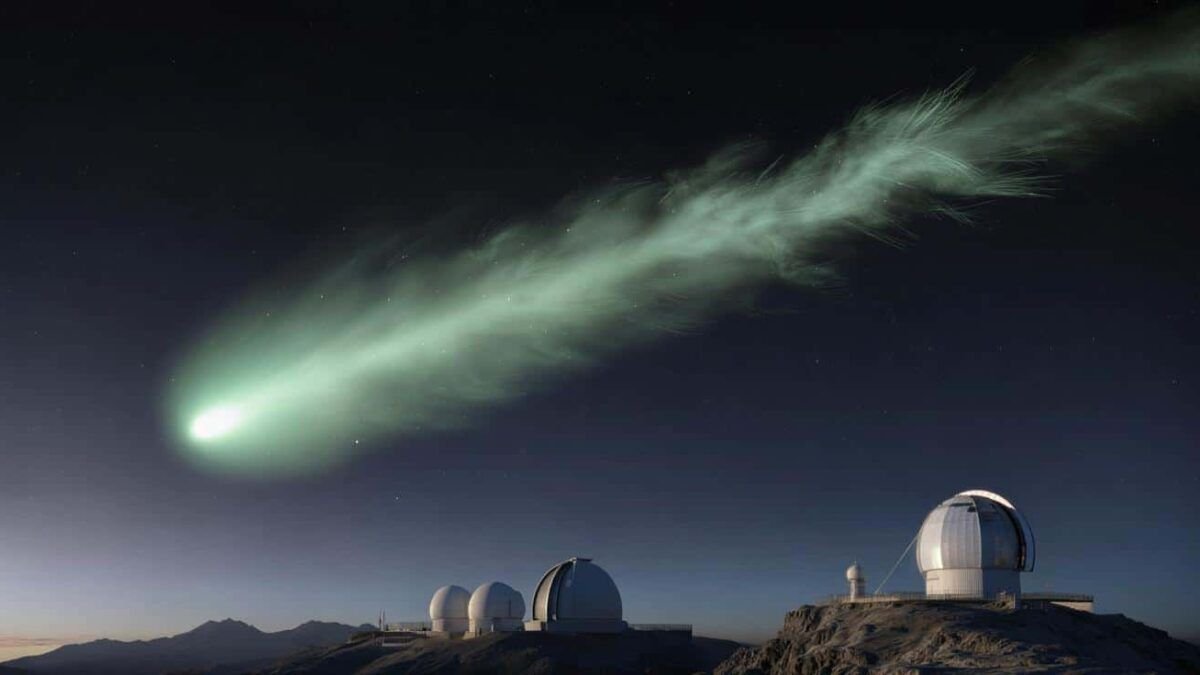
In the quiet predawn skies over Chile, astronomers held their breath as a mesmerizing emerald streak emerged on their monitors. This ghostly tail, twisting through the void, captured the essence of interstellar comet 3I ATLAS, a fleeting guest from beyond our Solar System. Captured by leading telescopes worldwide, these spectacular new images offer a front-row seat to one of the universe’s rarest spectacles.
From the peaks of Mauna Kea in Hawaii to the rugged heights of the Canary Islands, observatories united to document this wanderer. Each snapshot, taken in different wavelengths, peels back layers of its enigmatic journey, blending artistry with cutting-edge science. For stargazers and scientists alike, these visuals transform distant astronomy into vivid reality.
Unveiling the Enigmatic Beauty of Interstellar Comet 3I ATLAS
The interstellar comet 3I ATLAS stands as the third verified visitor from interstellar space to enter our cosmic backyard. Recent high-resolution photos showcase its delicate core shrouded in a luminous green coma, with a sprawling tail stretching across millions of kilometers. Shaped by solar winds and radiation, this tail reveals dynamic interactions unique to its alien origins.
Through the powerful optics of the Very Large Telescope (VLT) in Chile, the comet appears richly textured. Subtle bends in its tail suggest influences from its long voyage through the galaxy. Meanwhile, Gemini North on Mauna Kea delivered ultraviolet views highlighting a subtle gas envelope.
Key Features Highlighted in Ground-Based Imagery
Astronomers at La Palma’s Gran Telescopio Canarias described the moment the first sharp image loaded as electrifying. Infrared data hinted at unusual dust grains, distinct from Solar System comets. These findings evoke the thrill of discovering something truly otherworldly.
Its hyperbolic trajectory—too fast for the Sun’s gravity to bind—confirms its one-way trip through our system. Scientists analyze brightness shifts and tail shapes to map gas outflows and external forces. This data reconstructs the comet’s path from a far-off stellar nursery.
- Green coma: Ionized gases glowing under solar UV light.
- Warped tail: Evidence of magnetic fields and solar wind sculpting.
- Dim nucleus: A frozen relic preserving ancient chemistry.
The Worldwide Effort to Image 3I ATLAS
The discovery began with Hawaii’s ATLAS survey, a network of automated telescopes hunting for fast-moving objects. What started as a faint smudge quickly revealed an interstellar path through precise orbital calculations. This triggered a global frenzy among observatories.
Facilities from Chile to Spain vied for observing time, coordinating across continents. Teams adjusted instruments for optimal filters and exposures, battling the comet’s rapid motion. The result? A comprehensive dataset from diverse vantage points.
- Gemini North: Pivoted from deep-space galaxies to track this intruder in real-time.
- VLT in Chile: Provided the sharpest visible-light details under clear southern skies.
- Gran Telescopio Canarias: Excelled in high-altitude imaging, capturing fine tail structures.
Collaboration shone through instant alerts, shared data pipelines, and late-night video calls. Veteran observers spoke of rediscovered passion, merging rigorous protocols with pure wonder. These efforts turned a brief flyby into a treasure trove of images.
Unlocking Scientific Insights Through Advanced Observations
Analyzing Composition and Dynamic Behavior
These multi-wavelength images go beyond beauty, enabling detailed spectroscopy. Spectral lines indicate ices like water and carbon monoxide, possibly laced with exotic molecules from its home system. As the comet approaches the Sun, activity surges, revealing outgassing patterns.
Combined data refines its trajectory, predicting perihelion and future path. Tail deviations map non-gravitational forces, offering clues to its physical makeup. Such analysis bridges the gap between observation and interstellar chemistry.
Connecting Experts with the Public
For casual skywatchers, the images make “interstellar” feel real, dispelling myths like alien tech behind the green glow—it’s just excited atoms. Experts accompany releases with breakdowns:
- Exposure details and wavelength specifics.
- Current sky location and solar proximity.
- Apparent motion and magnitude changes.
- Unique contributions from each telescope.
- Open puzzles for ongoing research.
As one astronomer put it, each interstellar comet acts as a time capsule from distant worlds, carrying unaltered samples of stellar chemistry.
Broader Impacts on Astronomy and Our Understanding of the Universe
These observations estimate how many interstellar objects zip through our neighborhood unnoticed. Past surveys likely missed many, but modern tech changes that. Clues point to 3I ATLAS as a fragment from a shattered world or rogue ejection.
For enthusiasts, it paints the Solar System as a cosmic crossroads, where galactic debris mingles with local matter. Future facilities like the Vera C. Rubin Observatory will multiply detections, revolutionizing the field.
The images capture a rare convergence of stories from across the galaxy. They underscore global teamwork’s power in decoding the cosmos, reminding us of humanity’s shared gaze toward the stars.
Why Interstellar Comet 3I ATLAS Fascinates Everyone
Its extreme rarity—unbound by our Sun after eons in the void—fuels endless intrigue. Billions of years alone, now under humanity’s microscopes in mere weeks. This serendipity captivates scientists and dreamers alike.
Public interest explodes with interactive visuals and explainers. Educational outreach emphasizes:
- The blurry edges of our Solar System.
- Varied ingredients in planetary formation.
- How surveys expand our cosmic view.
In conclusion, the spectacular new images of interstellar comet 3I ATLAS ignite wonder and drive discovery. They invite us to look up, question our place in the vastness, and anticipate the next visitor. As it recedes into the dark, its snapshots ensure the magic lingers, inspiring generations to explore the stars.
Can I see interstellar comet 3I ATLAS with my own eyes?
How do astronomers confirm 3I ATLAS is interstellar?
What makes these new images of 3I ATLAS special?
Does 3I ATLAS pose risks to Earth?
Will more interstellar objects be found soon?
